

Beyond Oil Successfully Completes Industrial-Scale Validation of Patented Chemistry, Demonstrating Substantial Reductions in Harmful Frying-Oil Degradation Compounds
Independent pilot at industrial food-production facility delivers approximately 93% reduction in Free Fatty Acids and approximately 52% reduction in Total Polar Compounds versus untreated control
Results extend Beyond Oil’s validated technology into industrial frying amid tightening global regulation of frying-oil composition and worker exposure to frying-oil emissions
VANCOUVER, British Columbia, Aug. 17, 2026 (GLOBE NEWSWIRE) -- Beyond Oil Ltd. (TSX: BOIL) (OTCQB: BEOLF) (“Beyond Oil” or the “Company”), a food-tech innovation company dedicated to reducing health risks associated with fried food while improving food quality, minimizing waste and enhancing sustainability, today announced the successful completion of an independent industrial-scale pilot validating its patented filter-powder technology at an industrial food-production facility. The pilot represents the first validated application of Beyond Oil’s chemistry in the industrial-frying environment.
Key Results
- Approximately 93% reduction in Free Fatty Acids1 versus the untreated control, with treated-oil quality remaining within a narrow, stable range across the full production cycle.
- Approximately 52% reduction in Total Polar Compounds2 versus the untreated control, with the Beyond Oil-treated fryer remaining well below the 24% regulatory maximum3 throughout the pilot while the untreated control breached that threshold.
- Structured sensory-panel evaluation confirmed the Beyond Oil-treated product retained day-one characteristics across the full pilot period, with clearer and more golden oil, uniform crispness, consistent taste, and no burnt-oil or rancid odors.
- Materially reduced secondary odors in the plant environment during production, with direct implications for workplace conditions and worker exposure to frying-oil emissions over extended shifts.
- Integration with existing plant filtration infrastructure without requiring custom capital equipment, demonstrating operational compatibility of Beyond Oil’s chemistry with standard industrial-frying environments.
Jonathan Or, CEO of Beyond Oil, commented: “This pilot is a validation of what Beyond Oil’s chemistry is fundamentally about - improving frying across every dimension that matters: food quality, health, worker safety, and sustainability. While our near-term commercial focus remains firmly on the expansion of our direct-sales footprint in the United States for our core foodservice business, this milestone reflects longer-horizon work we have been advancing in parallel - validating that the same patented chemistry performs at industrial scale and delivers the same core outcomes: substantially cleaner oil, safer and higher-quality fried product, and a materially healthier working environment for the people producing that food. It confirms that our technology addresses a system-level problem in how the world produces fried food, independent of customer type or scale of operation, and reinforces the long-term significance of the industrial-frying opportunity for Beyond Oil.”
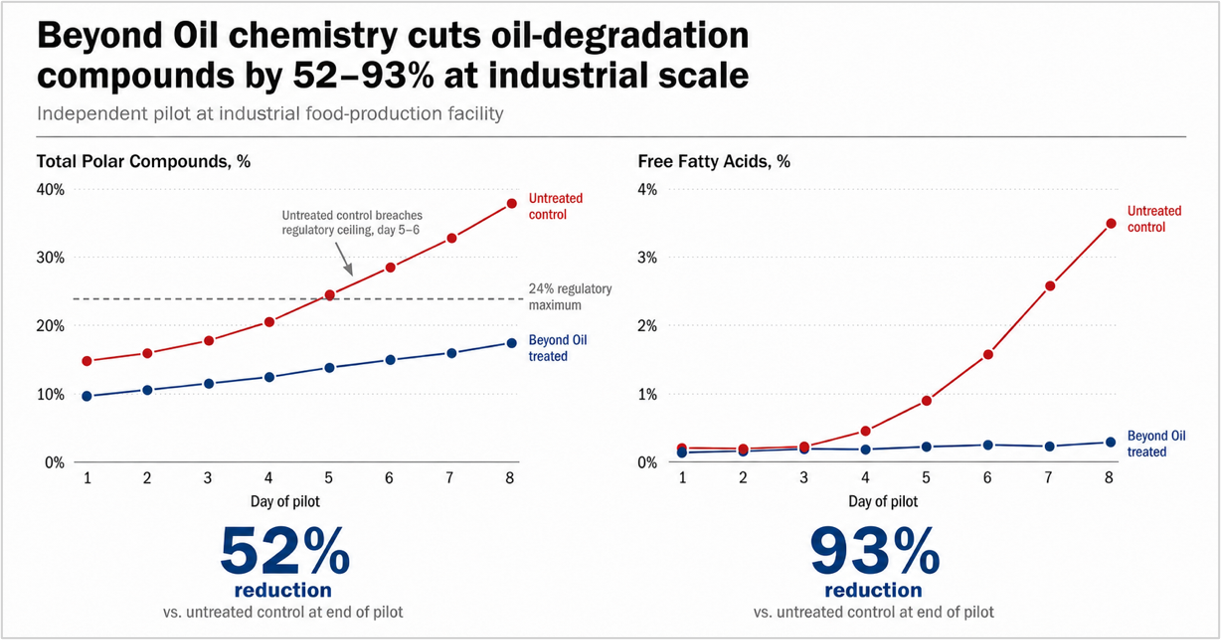
Industrial pilot results: approximately 93% lower Free Fatty Acids and approximately 52% lower Total Polar Compounds versus untreated control. Source: Data derived from the industrial-scale pilot described in this news release; regulatory maximum reference (24% TPC) per academic and industry-standard sources (see footnote 1).
The industrial-frying segment is a large, growing global market. The North American frozen French fries market alone, for example, was valued at approximately US$6.8 billion in 2022 and is projected to reach approximately US$8.1 billion by 20284, while the broader industrial-frying-machine market is projected to grow at a compound annual rate of approximately 7.4% from 2026 through 20345. The performance validated in this pilot underscores the long-term significance of this opportunity for Beyond Oil as the Company continues its principal near-term focus on scaling its foodservice business in the United States.
The pilot was conducted over multiple production days at an industrial food-production facility. Beyond Oil’s product was integrated into the plant’s existing filtration workflow at end-of-day cycles: hot oil was transferred to an auxiliary mixing and settling tank, treated with a specialized industrial version of Beyond Oil’s patented powder, and left overnight for phase separation. The following morning, the clean upper oil phase was returned to the fryer through the facility’s standard filtration equipment; the settled powder phase, containing absorbed food particles and degradation compounds, was removed as a low-volume waste stream. An identical untreated fryer was operated in parallel as a control.
Emissions from high-temperature frying are formally classified by the International Agency for Research on Cancer as a Group 2A (“probably carcinogenic to humans”) hazard6, and food-safety and occupational-health regulators across major markets have moved in recent years to tighten oversight of frying-oil composition, acrylamide levels in industrially-produced foods, and worker exposure to frying-oil emissions. Regulatory ceilings on Total Polar Compounds in frying oil are set at 24% to 25% across most major markets7, with enforcement activity rising in parallel. Beyond Oil’s technology is designed to address these converging pressures directly, at the point of oil degradation itself, rather than downstream of it.
Free Fatty Acids and Total Polar Compounds are the two most widely monitored indicators of frying-oil degradation. Both are directly associated with the formation of compounds linked to health risks, including acrylamide, polycyclic aromatic hydrocarbons, and trans fats, which accumulate in oil as it degrades and reach both consumers (absorbed into fried food) and production personnel (inhaled as vapor or absorbed through skin exposure). The stability observed in the Beyond Oil-treated fryer across the pilot period reflects consistent oil quality maintained across multiple production cycles - a materially different outcome from the accelerating degradation curve observed in the untreated control.
About Beyond Oil Ltd.
We all love fried food. Let’s make it better. Not by changing what people love. By improving the system behind it. Beyond Oil Ltd. (TSX: BOIL) (OTCQB: BEOLF) is a food-tech innovation company on a mission to help foodservice operators improve fried food across every dimension that matters: quality, health, consistency, safety, sustainability and profitability. We achieve these outcomes by improving the system behind every kitchen, the frying performance and oil management that determine what lands on the plate. The Company’s patented technology, cleared by the FDA and Health Canada, integrates into existing kitchen workflows to improve frying performance and oil management, helping operators deliver more consistent food, strengthen operational control and reduce oil waste. Beyond Oil’s solution serves restaurant chains, supermarkets, hotels, catering, institutions and industrial frying operations worldwide, turning frying into a measurable, repeatable and scalable brand standard. The result is a better frying standard, helping every fryer, every shift and every plate live up to the food people love. For more information, please visit: www.beyondoil.co.
Forward-Looking Statements and Information
Specific forward-looking statements in this news release include, but are not limited to, statements regarding: the Company’s plans to explore initial commercial implementation opportunities in the industrial-frying segment; the size, growth trajectory, and evolution of the industrial-frying market and related segments; the long-term significance of the reported pilot validation for the Company’s future business; the potential of Beyond Oil’s technology to address regulatory requirements, food-safety standards, or occupational-health concerns; and expectations regarding future pilot activity, customer discussions, and product adoption in the industrial-frying segment. There can be no assurance that any of these forward-looking outcomes will occur or that any exploration of commercial opportunities in the industrial-frying segment will result in material revenue or commercial engagements within any particular time period, or at all. This news release contains “forward-looking statements” within the meaning of the U.S. Securities Act of 1933, the U.S. Securities Exchange Act of 1934, “safe harbor” provisions of the United States Private Securities Litigation Reform Act of 1995 and “forward-looking information” within the meaning of other relevant securities legislation, including applicable securities laws in Canada, which reflect Beyond Oil Ltd.’s current views with respect to, among other things, its operations and financial performance (collectively, “forward-looking statements”). Forward-looking statements include statements that are predictive in nature, depend upon or refer to future results, events or conditions, and include, but are not limited to, statements which reflect management’s current estimates, beliefs and assumptions and which are in turn based on our experience and perception of historical trends, current conditions and expected future developments, as well as other factors management believes are appropriate in the circumstances. The estimates, beliefs and assumptions of Beyond Oil Ltd. are inherently subject to significant business, economic, competitive and other uncertainties and contingencies regarding future events and as such, are subject to change. Forward-looking statements are typically identified by words such as “expect”, “anticipate”, “believe”, “foresee”, “could”, “estimate”, “goal”, “intend”, “plan”, “seek”, “strive”, “will”, “may” and “should” and similar expressions. Although Beyond Oil Ltd. believes that such forward-looking statements are based upon reasonable estimates, beliefs and assumptions, certain factors, risks and uncertainties, which are described from time to time in our documents filed with the securities regulators in the USA and Canada, as well as factors not presently known to Beyond Oil Ltd., or that Beyond Oil Ltd. currently believes are not material, could cause actual results to differ materially from those contemplated or implied by forward-looking statements. Readers are urged to consider these risks, as well as other uncertainties, factors and assumptions carefully in evaluating the forward-looking statements and are cautioned not to place undue reliance on such forward-looking statements, which are based only on information available to us as of the date of this news release. Except as required by law, Beyond Oil Ltd. undertakes no obligation to publicly update or revise any forward-looking statements, whether written or oral, whether as a result of new information, future events or otherwise.
Neither the Toronto Stock Exchange nor its Regulation Services Provider (as that term is defined in the policies of the Toronto Stock Exchange) accepts responsibility for the adequacy or accuracy of this release.
Company Contact:
Adi Olesker, VP of Investor Relations
Phone: +972-50-694-2517
adio@beyondoil.co
Investor Relations Contact:
Arx Investor Relations
North American Equities Desk
BOIL@arxhq.com
A photo accompanying this announcement is available at https://www.globenewswire.com/NewsRoom/AttachmentNg/79e6d0fe-2e20-4a43-8944-fcfe6aadae6c
________________________________
1 Free Fatty Acids ("FFA"): a widely used indicator of frying-oil degradation, measuring the accumulation of hydrolytic-breakdown products of triglycerides. Elevated FFA levels are associated with reduced oil stability, off-flavors, and diminished frying performance.
2 Total Polar Compounds ("TPC"): the primary regulatory indicator of frying-oil degradation used across most major jurisdictions, measuring the cumulative concentration of oxidation, hydrolysis, and thermal-degradation products in used frying oil.
3 Regulatory maximum of 24% Total Polar Compounds (TPC) in frying oil per the DGF (German Society for Fat Science) standard, referenced across major European and North American jurisdictions. See Chen et al., Feasibility of total polar compound and its five components to evaluate the deterioration of heated and fried oil: Aspect of regulations of various countries, LWT – Food Science and Technology (Elsevier), 2022. Available at: https://www.sciencedirect.com/science/article/pii/S002364382201088X.
4 IMARC Group, North America Frozen French Fries Market (via Potato Business), 2023. Available at: https://www.potatobusiness.com/market/primary-factors-driving-the-north-american-frozen-french-fries-market/.
5 The Insight Partners, Industrial Frying Machine Market Size, Share & Demand by 2034. Available at: https://www.theinsightpartners.com/reports/industrial-frying-machine-market
6 IARC Monographs on the Identification of Carcinogenic Hazards to Humans, Volume 95: Household Use of Solid Fuels and High-Temperature Frying, International Agency for Research on Cancer, World Health Organization. Available at: https://publications.iarc.who.int/Book-And-Report-Series/Iarc-Monographs-On-The-Identification-Of-Carcinogenic-Hazards-To-Humans/Household-Use-Of-Solid-Fuels-And-High-temperature-Frying-2010.
7 Regulatory maxima on Total Polar Compounds in frying oil are established at 24% in Germany, France, and the United States, and at 25% in Belgium, Italy, Spain, and Portugal, among other jurisdictions. See Chen et al., Feasibility of total polar compound and its five components to evaluate the deterioration of heated and fried oil: Aspect of regulations of various countries, LWT – Food Science and Technology (Elsevier), 2022. Available at: https://www.sciencedirect.com/science/article/pii/S002364382201088X.


Industrial pilot results
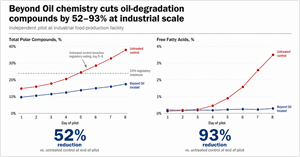
Approximately 93% lower Free Fatty Acids and approximately 52% lower Total Polar Compounds versus untreated control. Source: Data derived from the industrial-scale pilot described in this news release; regulatory maximum reference (24% TPC) per academic and industry-standard sources (see footnote 1).
Legal Disclaimer:
EIN Presswire provides this news content "as is" without warranty of any kind. We do not accept any responsibility or liability for the accuracy, content, images, videos, licenses, completeness, legality, or reliability of the information contained in this article. If you have any complaints or copyright issues related to this article, kindly contact the author above.
